EDR or XDR - which solution fits your organization?
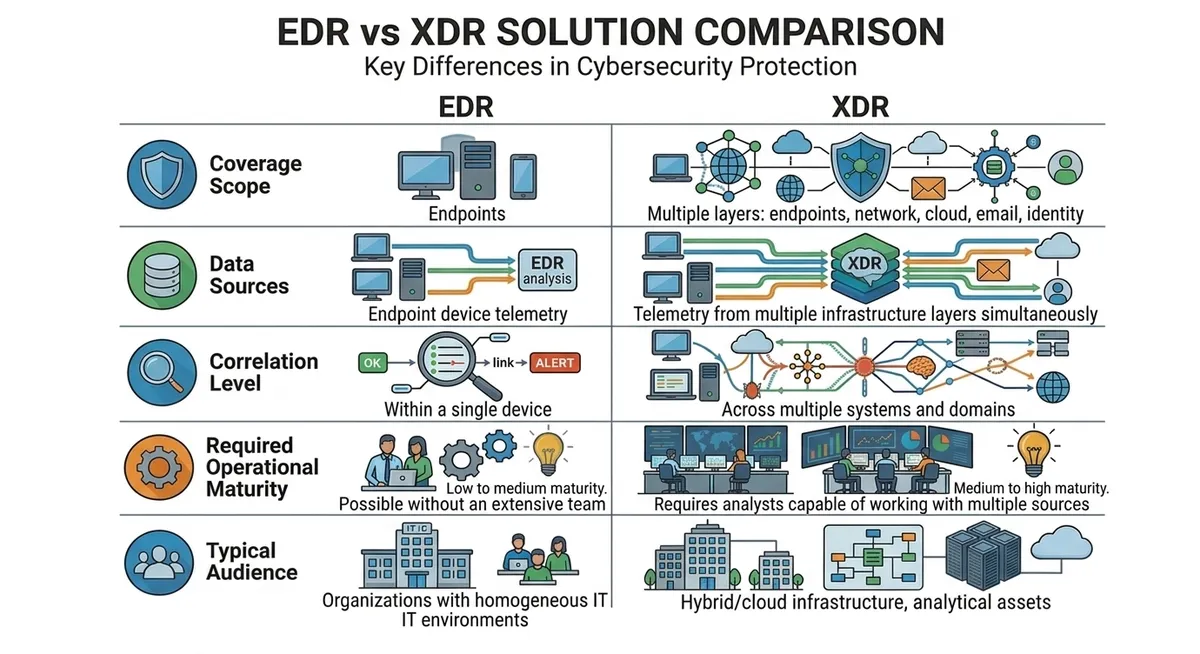
EDR (Endpoint Detection and Response) is a category of software that monitors activity on endpoints - computers, servers and company phones - and detects suspicious behavior in real time. XDR (Extended Detection and Response) extends this scope: it collects data not only from devices but also from networks, email, cloud environments and identity systems, then correlates them into a single picture. Both approaches serve to detect threats and respond to them - they differ in scope, required operational maturity and the type of IT environment they were designed for.
Starting point - why antivirus alone is no longer enough
Most attacks do not start and end on a single device. Attackers gain access through email, move laterally across the network, escalate privileges in Active Directory and only then strike their target. According to CrowdStrike Global Threat Report 2026, the average time from initial breach to the moment an attacker begins lateral movement was just 29 minutes in 2025 - 65% faster than the previous year. Within this window, the organization must detect and respond to the threat. Traditional antivirus captures only a fragment of this chain. EDR and XDR were created as an answer to this problem, but each approach solves it differently...
Where EDR protection ends - and what remains beyond its reach
EDR monitors activity at the endpoint level - workstations, servers and mobile devices. It records processes, network connections initiated from the device, registry changes and file behaviors. Based on this, it detects suspicious patterns and enables rapid response - device isolation, attack analysis, malware removal.
It works well where the threat is concentrated on the endpoint. Its limitation is the lack of context from other infrastructure layers. In 2025, 82% of detected attacks were "malware-free". Attackers used legitimate system tools, applications and credentials instead of malicious software (CrowdStrike Global Threat Report 2026). This means attackers increasingly move through environments in ways that do not generate alerts directly on the device - and that is precisely where EDR has its scope. If a breach starts with a compromised email account and then proceeds through cloud resources, EDR may register individual events but will not connect them into a coherent incident picture.
What XDR brings - when broader scope changes the risk equation
Extended Detection and Response expands detection scope beyond endpoints. It collects and correlates data from multiple sources simultaneously - email, network traffic, cloud environments, IdP (Identity Provider) systems and applications. The goal is to build a single, coherent incident picture instead of many isolated alerts from different tools. The number of attacks targeting cloud environments grew by 37% in 2025, and compromised user accounts were responsible for 35% of cloud incidents (CrowdStrike Global Threat Report 2026) - pointing directly to the gap that EDR systems cannot fill.
The key difference lies not in the number of monitored sources but in correlation. XDR connects events that in separate tools would look like unrelated anomalies, creating a single operational context. This changes the way incidents are handled - instead of manually cross-referencing logs from multiple systems, you get a ready-made picture of the event chain.
EDR and XDR by operational criteria
The table below compares both approaches by criteria that matter for purchasing decisions - not by technical parameters, but by what a given solution means in practice for the organization and its team.
Protection scope
- EDR: Endpoints - workstations, servers, mobile devices
- XDR: Multiple layers - endpoints, network, cloud, email, identity
Data sources
- EDR: Telemetry from the endpoint device
- XDR: Telemetry from multiple infrastructure layers simultaneously
Correlation level
- EDR: Within a single device
- XDR: Across multiple systems and domains
Required operational maturity
- EDR: Low to medium - possible without a large team
- XDR: Medium to high - requires analysts capable of working with multiple sources
Typical audience
- EDR: Organizations with a homogeneous IT environment
- XDR: Hybrid/cloud infrastructure, analytical resources
Selection criteria - how to match the solution to organizational maturity
The most common mistake when choosing between EDR and XDR is evaluating the solution in isolation from the team that will use it. XDR generates richer context but does not interpret itself. An organization that does not have an analyst capable of working with correlated alerts from multiple infrastructure layers will not fully leverage XDR's potential.
EDR is a reasonable starting point for companies that are just building detection and response capabilities. It provides visibility on the most frequently attacked layer, is relatively simpler to deploy and does not immediately require an elaborate analytical process. It can be extended to XDR as the team and infrastructure mature.
XDR makes sense when the organization already has a working EDR, uses cloud or hybrid environments and has a team capable of working with multiple data sources simultaneously. The decision to move to XDR should stem from a real diagnosis - from determining that current tools leave blind spots - not from the mere availability of technology on the market.
It is also worth considering a managed model. Some vendors offer XDR as a managed service, shifting the analysis burden to an external operations team. According to Gartner, XDR deployments are primarily aimed at organizations with smaller security teams that do not fully utilize SIEM or SOAR platforms - confirming that the managed model is a more pragmatic path for many companies than building analytical competencies from scratch.
How ICWT approaches EDR and XDR deployments
ICWT's portfolio includes solutions covering both approaches - including Heimdal Security as a platform combining endpoint protection with vulnerability management, and CrowdStrike Falcon as an XDR-class environment capable of correlating data from multiple infrastructure layers. The choice between them is always preceded by analysis of the client's current environment, team maturity and real protection gaps - not the other way around. If you face a similar decision and want to assess which approach fits your organization, contact us and schedule a free consultation.
FAQ
What is the difference between EDR and XDR?
EDR (Endpoint Detection and Response) monitors activity on endpoints - computers, servers and phones. XDR (Extended Detection and Response) extends this scope to network, email, cloud and identity systems, correlating data from multiple sources into a single incident picture.
When is EDR sufficient and when do I need XDR?
EDR is sufficient for organizations with a homogeneous IT environment that are just building detection capabilities. XDR makes sense when a company uses cloud or hybrid environments, already has a working EDR and has a team capable of working with correlated alerts from multiple infrastructure layers.
Can I transition from EDR to XDR gradually?
Yes. EDR is a natural starting point that can be extended to XDR as the team and infrastructure mature. Many platforms offer a modular approach, allowing you to add data sources without replacing the entire system.
What does "operational maturity" mean in the context of EDR and XDR?
Operational maturity is the team's ability to work effectively with the tool. EDR requires low to medium maturity - it can be managed without a large SOC team. XDR requires medium to high maturity - analysts capable of interpreting correlated alerts from multiple domains.
Does XDR replace SIEM?
XDR does not fully replace SIEM but takes over some of its functions - especially event correlation and response automation. For organizations with smaller security teams, XDR can be a more pragmatic solution than a full-scale SIEM or SOAR.